


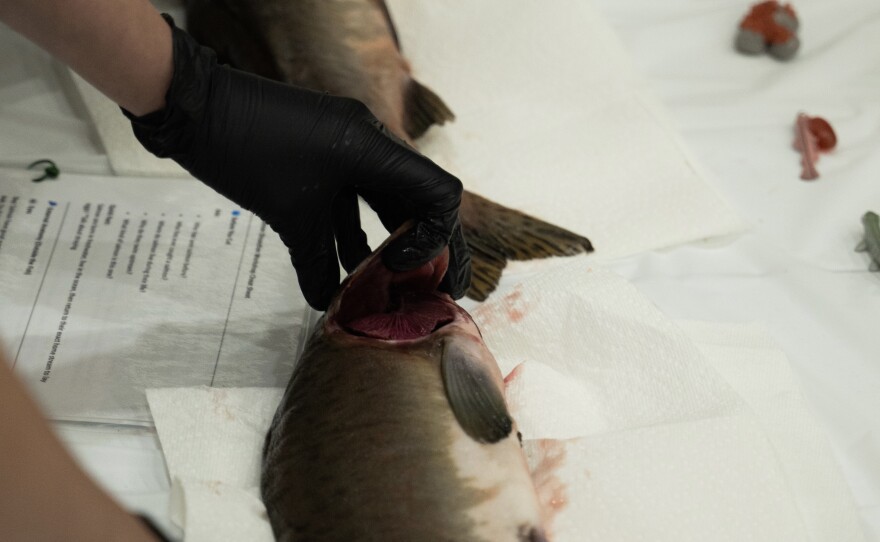

On April 6, the cafeteria at Main Elementary School smells unusually fishy. Plastic sheets cover the tables instead of lunch boxes. And instead of tasty snacks, Main Elementary’s fourth graders hold salmon organs.
These organs are part of a class dissection under a program called Salmon in the Classroom. Biologists at the Kodiak Regional Aquaculture Association, who ran the dissection, say it’s an important way for kids to get hands-on experience with the salmon life cycle, and their local hatcheries.
This program isn’t unique to Kodiak, or even to Alaska. State agencies, like the Alaska Department of Fish and Game, make Salmon in the Classroom curriculum available to schools across the country. In Kodiak, where the program is run by KRAA, it has been going on for over a decade at
“I'm happy they're still doing it, because when I went here, we also did a salmon dissection in the classroom in fourth grade,” said Joresa Reyes, a graduate of the Kodiak school system and an aide for some of the kids in this fourth grade class. "It's kind of full circle seeing them doing it."
Some kids are excited to share everything they know about salmon. Others are a little less jazzed.
“I just don’t like them, because whenever I see something get dissected I puke," said one student. "The insides, they gross me out.”

Another big part of the months-long Salmon in the Classroom program is that the students get to raise baby salmon. KRAA sent over salmon eggs in November, which the teachers are in charge of incubating and then caring for until mid-May. The kids get to watch the eggs grow up into fry over several months, then they will release them back into the wild.
Amy Arneson, a fourth grade teacher at Main who is helping run the salmon program, said the program has been a great hands-on experience for the kids.
“Seeing the process and everything makes it so much more real," she said. "Just reading about it isn't quite the same as when they get to see it and notice like, ‘Oh yeah, look at them using their swim bladders, they do look like little toddlers trying to learn how to walk.’”
But that’s not the only way the kids can connect to the salmon they raise. Kyle Woolever, the research manager at KRAA, explained how hatcheries can identify their fish when they’re harvested.
“These are called otoliths," he explained to the students. "They're the ear bones, and we put marks on them just like this with changing the water temperature. That's the bar code to say where the fish came from. We know exactly when and where that fish was spawned, and that's how we know our fish from any other fish."

Just like hatchery fish, the salmon the kids are raising at school have specific markings on their ear bones. So if a Main fourth grader catches one of their salmon in the wild years down the line, they’ll be able to tell it was theirs, according to KRAA biologist Tina Weaver.
“They'll even have the chance, maybe, to go back to Mill Bay and catch them when they return back," Weaver said. "So it's pretty cool that they get the chance to see the entire life cycle.”
In Kodiak, hatcheries' fish accounted for 27% of the total salmon catch in 2025.
The class will release their 250 salmon fry, if they all survive, that is, one by one into Island Lake in just over a month. The fish will eventually become food for other animals, part of a fisherman’s catch of the day, or nutrients for forests and streams.


