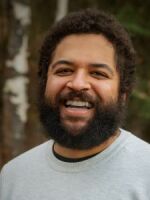
When the remnants of Typhoon Halong blew through Kwigillingok in October, Lucy Martin sheltered in her home with her boys and her father.
“Just after 2:15 a.m., I looked out the window and I saw graves rolling, graves and caskets rolling,” Martin said. “It was a real-life horror movie for me.”
Martin spoke at a roundtable in Anchorage on Tuesday convened by U.S. Sen. Lisa Murkowski. The goal was for federal officials to hear from Kipnuk and Kwigillingok leaders about challenges the communities still face and ideas for how to move forward.
Kipnuk Village Chief Paul J. Paul recounted his own harrowing story of surviving Halong. Debris, sewage and fuel contaminated the landscape, as his family holed up in their home, Paul said.
“Intense wind, tidal water. Late evening, 10 of my grandkids transferred to my house. Six adults. Strong wind, heavy seas, waves starting to hit my house, peeled out my outer layer of plywood from my house,” he said.
Paul teared up as he spoke, his voice cracking as he spoke of his daughter asking them to sing “Silent Night,” hoping for relief as the family prayed together.

Joining Murkowski at the roundtable was fellow Sen. Dan Sullivan and Billy Kirkland, Assistant Secretary for Indian Affairs with the Department of Interior. Their place was not to introduce policy or their own ideas, but to listen.
“We're, I don't want to say excited to be here, because obviously I'd much rather be here for a different situation,” Kirkland said. “But we're happy to be a part of the process of healing that we have the ability to do.”
One idea came up again and again during the discussion: relocation.
Before the storm hit, said Dustin Evon, tribal resilience coordinator for Kwigillingok, the village was already weighing the impacts of a warming climate, like thawing permafrost and increased river erosion.
“Preliminary projections showed that Kwig would be at great risk within 10 to 20 years,” Evon said. “However, Typhoon Halong took care of that in one night.”
“This will not be the only storm,” he added.
Martin, who works with Evon, said she visited the village in February and March, and noticed that patches of tundra had disappeared.
“When I walk on raw ground, it's like walking on a water bed or just on a jello pad,” Martin said. “The land sunk even lower. Our land is no longer safe for year-round living.”

Rayna Paul, tribal administrator for Kipnuk, said an additional issue is that the state is not communicating with tribes before sending contractors in for debris cleanup and other recovery efforts.
“The state has been charging forward with hiring contractors to do work in our village without consultation,” she said. “This violates our tribal sovereignty”
The problems for community members extend far from their home villages. Hundreds of Western Alaskans were evacuated and relocated to larger cities like Anchorage after the storm. While tribal leaders expressed gratitude to the cities for taking them in, Martin said her community members are facing new challenges.
“People are already struggling with housing,” she said. “Our children are being bullied at schools. Many of our tribal members are struggling with mental health because of the trauma we went through, and we already lost two youth to suicide.”
Others expressed concern over a lack of access to traditional foods and subsistence hunting opportunities.
Tribal members in both communities have voted overwhelmingly to relocate to higher ground. But there are barriers, including costs, as well as varying jurisdiction over state, federal and tribal land.
There’s currently no federal pathway for relocation of this kind, Rayna Paul said.
“There is no current program for relocation, and no agency that handles relocation and no source of funding for relocation,” she said. “This forces relocating communities to try to navigate very complicated processes on their own.”
Paul proposed a pilot project to set up an interim village in rural Alaska. It should be funded and coordinated by multiple agencies in collaboration with tribes, where both communities can rebuild, she said.
“Both Kipnuk and Kwigillingok can come together,” Paul said. “We can support each other, heal together, be a community again. This will help give us a sense of grounding that we desperately need.”
Paul said she hoped the pilot project would set a blueprint for wider federal relocation policy.
A similar roundtable is scheduled for Wednesday in Bethel, Murkowski said.